How to Survive Difficult Times

Difficult times are a part of life, but they do not have the final word. Seasons of pressure, loss, confusion, or delay can shake your strength and challenge your faith, yet they also reveal where your trust truly lies. Surviving difficult times begins with understanding that hardship does not mean God has abandoned you. Often, it is in the hardest seasons that God works most deeply within us.The first key to surviving difficult times is staying anchored in God’s presence. When circumstances are unstable, God remains constant. Prayer may feel harder in difficult seasons, but it becomes more necessary. Even simple prayers, spoken with honesty, keep your heart connected to God. God is close to the brokenhearted and attentive to those who cry out to Him.Another important step is guarding your mind. Difficult times often come with negative thoughts, fear, and discouragement. What you allow into your mind will shape how you endure the season. Choosing to hold on to truth, hope, and God’s promises strengthens your inner life and prevents despair from taking over.Patience is also essential. Difficult times often tempt people to rush decisions out of fear or frustration. Learning to wait on God, even when answers seem delayed, protects you from unnecessary mistakes. Waiting does not mean doing nothing; it means trusting God while continuing to do what is right.Surviving difficult times also requires accepting support. God did not design people to walk through pain alone. Trusted relationships, wise counsel, and encouragement from others provide strength when your own feels insufficient. Allowing others to stand with you is not weakness; it is wisdom.Rest is another vital part of endurance. When pressure is constant, exhaustion follows quickly. Taking time to rest, reflect, and restore strength helps you face challenges with clarity rather than panic. God values rest because He knows that renewal sustains endurance.Most importantly, hold on to hope. Difficult times are seasons, not destinations. They do not define your future or cancel God’s purpose for your life. Growth, maturity, and strength are often formed in these moments. Even when you cannot see the outcome, trust that God is working behind the scenes.You survive difficult times one day at a time. Stay rooted in God, protect your mind, lean on support, and refuse to give up hope. This season will pass, and when it does, you will emerge stronger, wiser, and more grounded than before.


The power of Divine Alignment

Divine alignment is the place where your life, choices, and efforts come into agreement with God’s will. It is the difference between striving and flowing, between exhaustion and fruitfulness. Many people labor sincerely yet see little result, not because they lack effort, but because alignment is missing. When alignment is restored, strength is renewed and progress becomes meaningful.Divine alignment begins when God takes the lead. Life becomes burdensome when we plan independently and later ask God to bless our decisions. Alignment reverses that order. It places God at the center, allowing Him to direct steps, priorities, and timing. When God leads, effort is no longer wasted, because every step is purposeful.Alignment brings clarity. Confusion often arises when we pursue good things outside God’s timing or assignment. Divine alignment brings focus by removing distractions and unnecessary struggles. It simplifies life by helping us discern what belongs to our season and what does not. When clarity comes, peace follows.Divine alignment also protects from laboring in vain. Many people are tired because they are pushing in areas God never assigned to them. Alignment brings rest, because you are no longer forcing doors that God has not opened. What God aligns, He sustains. What He sustains, He multiplies.Another power of divine alignment is fruitfulness. When a life is aligned with God, growth becomes natural. Effort produces results, seeds yield harvest, and labor carries meaning. Even challenges become productive, because they are working toward God’s purpose rather than against it.Divine alignment strengthens the inner life. It aligns the heart, the mind, and the spirit with truth. Fear reduces, confidence increases, and decisions become clearer. Alignment does not remove responsibility, but it removes unnecessary pressure. You work with God, not against His plan.Ultimately, divine alignment is an invitation to trust God fully. It requires surrender, obedience, and patience. But the reward is a life built by God, sustained by His grace, and directed by His wisdom. When alignment is restored, life regains balance, purpose, and lasting impact.

Prayer for Divine Alignment

Father, I come before You and I surrender my life completely. Align my heart, my mind, my decisions, and my steps with Your perfect will. Remove every form of self-direction, confusion, and misalignment that has caused me to labor in vain.

Lord, align my marriage, my family, my ministry, and my work with Your purpose. Let my efforts agree with Your timing and my actions flow from Your instruction. Where I have been striving in my own strength, realign me to walk in Your grace.

Father, disconnect me from assignments, relationships, and pursuits that are not from You, even if they look good. Order my priorities according to Your will and give me the wisdom to know what belongs to this season of my life.

Align my thoughts with truth, my desires with Your heart, and my plans with Your counsel. Let every decision I make be guided by Your Spirit. Restore clarity where there has been confusion and peace where there has been pressure.

Lord, I place every labor, sacrifice, and effort into Your hands. Build my life according to Your design so that I will not labor in vain. Let my life bring lasting fruit and glory to Your name. In Jesus’ name, Amen.

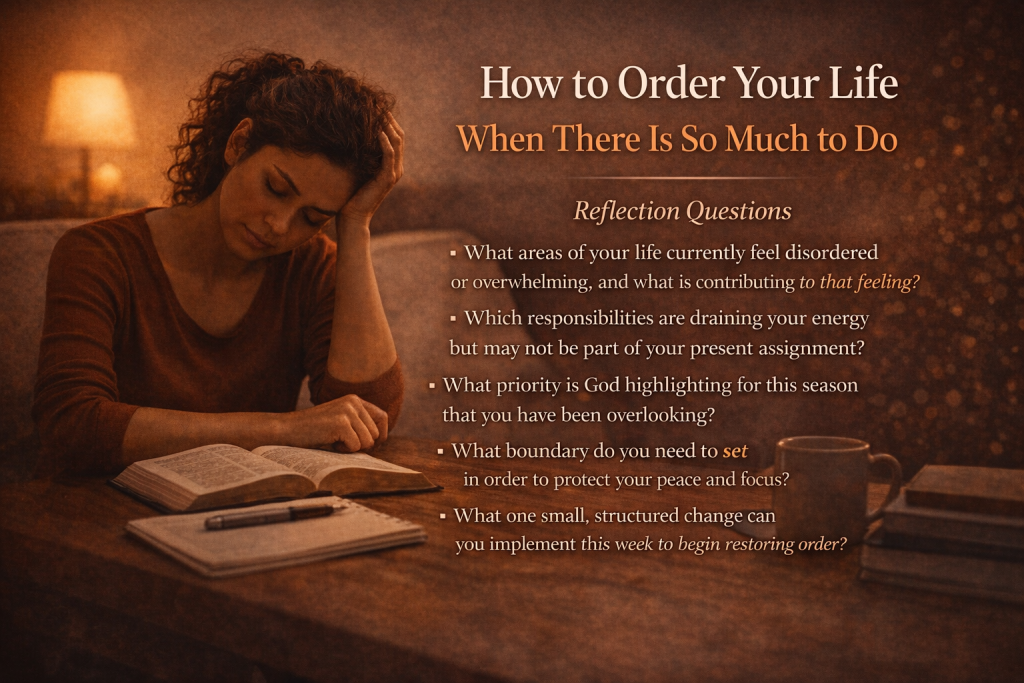
How to Order Your Life When There Is So Much to Do


Overwhelm is often a sign that order is missing. When life becomes crowded with responsibilities—family, marriage, work, ministry, personal growth, and spiritual life—everything begins to compete for attention at the same time. The problem is rarely the amount of work; it is the absence of alignment. When order is missing, even good responsibilities become heavy.

Order begins in the mind before it shows up in the schedule. A cluttered mind produces a cluttered life. God is not the author of confusion but of peace, and when peace is missing, it is an invitation to pause and realign. First Corinthians 14:33 reminds us that God operates through order and clarity, not chaos. Restoring order starts with slowing down long enough to hear clearly again.

Clarity of priority is essential when everything feels urgent. Not every demand deserves your energy, and not every opportunity belongs to your current season. Jesus addressed this in Luke 10:41–42 when He told Martha that she was distracted by many things while neglecting what mattered most. Wisdom understands timing. Purpose unfolds in seasons, and growth requires discernment about what belongs to now and what can wait.

Urgency and importance are not the same. Pressure often disguises itself as responsibility, but wisdom separates the two. Proverbs 24:3–4 teaches that through wisdom a house is built and through understanding it is established. Order increases when boundaries are clear. Without boundaries, everything feels urgent and nothing feels intentional.

Structure becomes necessary when life feels overwhelming. Structure is not about control; it is about alignment. Simple routines for prayer, work, rest, and growth create stability in the midst of responsibility. Even Jesus lived with intentional structure. Mark 1:35 shows Him withdrawing early to pray despite constant demands. If structure sustained Jesus, it is essential for anyone seeking balance and clarity.

Order also requires releasing what God did not assign. Carrying unnecessary responsibilities creates exhaustion and confusion. John 9:4 reminds us to work the works of Him who sent us, not every work presented to us. Not every good thing is your assignment. Alignment increases when obedience replaces people-pleasing.

Rest is not a break from order; it is part of it. Rest restores perspective and renews strength. Isaiah 30:15 teaches that in quietness and confidence is strength. When rest is ignored, disorder increases. When rest is honored, clarity returns.

Life does not become ordered by doing everything at once. It becomes ordered by doing the right things in the right sequence. Ask God for wisdom daily, simplify intentionally, and allow growth to be gradual. Order is not produced by rushing; it is established through alignment.

Reflection Questions

What areas of your life currently feel disordered or overwhelming, and what is contributing to that feeling? Which responsibilities are draining your energy but may not be part of your present assignment? What priority is God highlighting for this season that you have been overlooking? What boundary do you need to establish to protect your peace and focus? What one small, structured change can you implement this week to begin restoring order?


Growth Requires Structure, Not Motivation

Many women are waiting to feel motivated before they act. They tell themselves they will start when they feel inspired, confident, or emotionally ready. But motivation is unreliable. It rises and falls with emotions and circumstances. Growth, however, does not respond to motivation; growth responds to structure. Proverbs 16:3 reminds us, “Commit your works to the Lord, and your plans will be established.” Growth begins with commitment, not feelings.Motivation is emotional, but structure is intentional. Motivation depends on how you feel, while structure depends on what you have decided. Women who grow consistently are not always motivated; they are structured. They have rhythms, boundaries, and routines that support their growth even on days when they feel tired, confused, or discouraged. Discipline anchored in structure keeps growth moving forward.Many women stop progressing because their lives lack structure. Their days are reactive instead of intentional. Prayer happens when there is time, rest happens only after exhaustion, learning happens randomly, and personal growth is treated as optional. Yet 1 Corinthians 14:40 says, “Let all things be done decently and in order.” Where order is missing, progress becomes difficult.God is a God of order, not confusion. Throughout Scripture, growth followed structure. God gave Noah clear instructions before deliverance came. Jesus lived a life of routine prayer and withdrawal, even while carrying great responsibility. Luke 5:16 says, “So He Himself often withdrew into the wilderness and prayed.” Even spiritual strength was sustained through structured habits.Structure does not mean rigidity; it means alignment. It means deciding when you pray, how you grow, what you protect, and what you refuse to compromise. Structure creates space for consistency, healing, rest, and obedience to function together. Proverbs 4:26 instructs us to “ponder the path of your feet, and let all your ways be established.” Establishment follows intentional planning.Many women say they are stuck, but in reality, they are unstructured. They want clarity without order, progress without discipline, and growth without boundaries. But clarity often comes after structure is established. Habakkuk 2:2 says, “Write the vision and make it plain.” When life is organized around what matters, direction becomes clearer.If you desire growth, start small and structured. Choose simple routines you can sustain. Decide specific times for prayer, learning, rest, and reflection, and protect those times. Galatians 6:9 encourages us not to grow weary in doing good, because in due season we will reap if we do not give up. Structure helps you remain faithful until the harvest comes.You do not need to feel ready to grow. You need to be willing to structure your life around where God is leading you. Motivation may start you, but structure will keep you there. When structure is intentional, growth becomes inevitable.

Why Rest Is Part of Obedience

Many women believe rest is optional. Some even see it as laziness, so they push harder, do more, and stay busy both spiritually and physically. Yet exhaustion increases, clarity reduces, and joy fades. The truth is simple but often ignored: rest is not a reward; rest is obedience.God built rest into the rhythm of growth. Rest was not created because man was tired; rest was created because God is wise. Before sin entered the world, rest already existed. Genesis 2:2 tells us that God ended His work and rested. If God Himself modeled rest, then rest cannot be weakness.Many women struggle to rest because they tie their worth to productivity. They fear falling behind, feel guilty when they stop, and equate busyness with faithfulness. But exhaustion is not proof of obedience. Sometimes, it is proof of imbalance. God never asked you to prove your devotion by destroying yourself.Rest protects your discernment. When you are constantly tired, you misinterpret instructions, make emotional decisions, lose sensitivity to God’s leading, and confuse urgency with importance. Rest sharpens your spiritual hearing. You don’t just need strength; you need clarity.Burnout is not a badge of honor. Being busy for God does not mean being led by God. God never called you to damage your health, peace, or emotional stability in the name of service. Rest preserves your joy, protects your body, sustains your calling, and extends your longevity. You serve better when you are whole.Rest is an act of trust. Rest says, “God, I trust You enough to stop.” It declares that you believe God is in control, that you don’t need to force outcomes, and that you trust the process of growth. Rest is faith expressed through surrender.Practicing rest does not always mean sleeping. Rest means intentional pause. It can look like stepping away from constant activity, creating margin in your schedule, saying no without explanation, or being still without productivity. Rest is not inactivity; it is alignment.Take time to reflect honestly. Where have you been overworking instead of trusting God? What area of your life needs rest right now? What boundary do you need to set to protect your peace? Growth accelerates when rest is honored.You don’t grow by doing more alone. You grow by honoring rhythm. Discipline keeps you consistent, healing keeps you whole, and rest keeps you aligned. Obedience includes knowing when to stop.

Overcoming the Spirit of Depression

Depression is real, but it is not who you are. It affects emotions, thoughts, and strength, yet it does not have the final authority over your life. God’s intention is restoration, light, and renewed strength, even when the soul feels heavy. Darkness may visit, but it does not get to define your future.The journey toward healing begins with honesty before God. Faith does not require pretending everything is fine. Scripture shows that God welcomes sincere cries of the heart. When the soul is burdened, God draws near with compassion and understanding. Acknowledging pain is not weakness; it is the first step toward freedom.Depression often feeds on negative thoughts and distorted conclusions about life, worth, and hope. God’s Word calls us to renewal of the mind. Healing begins as truth replaces lies and hope is intentionally restored. This renewal happens daily, sometimes slowly, as the heart learns to align with God’s promises rather than fear or despair.God’s presence is a powerful source of restoration. Even when prayer feels difficult and strength feels low, God remains near. Stillness before Him, quiet trust, and simple prayers invite peace into the soul. God strengthens those who lean on Him, even when their strength feels depleted.Healing is also supported through connection. God did not design people to walk through heavy seasons alone. Support from trusted believers, leaders, or helpers brings encouragement and perspective. Community helps lift burdens that feel too heavy to carry alone.Rest plays an important role in overcoming depression. Emotional and physical exhaustion can deepen the struggle. God values rest as a pathway to renewal. When rest is honored, clarity returns and strength is gradually restored.Hope must be intentionally guarded. Depression often whispers that nothing will change, but God’s truth speaks differently. Hope grows as God’s promises are remembered and trusted again. Even small steps toward light matter.Overcoming depression is a process, not a performance. Healing takes time, patience, and grace. This season does not cancel your calling, and it does not determine your future. God restores joy, strength, and purpose in His time. You are not alone, and restoration is possible.

Woman, You Have a Ministry

Ministry is not limited to a pulpit, a microphone, or a title. Many women assume they do not have a ministry because they are not preaching publicly or leading a church. But ministry simply means serving God by impacting lives with what He has placed inside you. If God has entrusted people, influence, compassion, wisdom, or responsibility to you, then you have a ministry.Your ministry may begin in your home. Teaching, nurturing, praying, counseling, supporting, and guiding are all forms of ministry. The Bible tells us in Titus 2 that women are called to teach, nurture, and guide others in wisdom and godly living. Ministry often starts quietly before it is ever seen publicly.Your ministry may be expressed through your character. How you live, speak, forgive, and endure challenges communicates Christ to others. Second Corinthians 3:3 reminds us that our lives are letters read by men. People are watching how you respond to pressure, disappointment, and growth. Your life itself carries a message.You may also have a ministry of encouragement, prayer, leadership, service, or restoration. Some women carry a burden to intercede. Others carry wisdom to counsel. Some are called to organize, support, teach, or build quietly behind the scenes. First Peter 4:10 instructs us to use whatever gift we have received to serve others faithfully. No gift is small when it is surrendered to God.Ministry does not always look dramatic, but it is always purposeful. God often entrusts women with ministries that shape lives deeply and last long. Influence is not measured by visibility; it is measured by impact. What you do consistently in obedience matters to God.It is also important to understand that your ministry develops in seasons. You may be in a season of preparation, growth, or healing. This does not mean your ministry is absent; it means it is being strengthened. God often develops the woman before He enlarges the work. Isaiah 60:22 reminds us that God makes everything beautiful in its time.Do not compare your calling with others. Comparison creates discouragement and confusion. God did not ask you to be another woman; He asked you to be faithful with what He placed in your hands. When you embrace your assignment with humility and obedience, God multiplies its impact.Woman, you have a ministry. It may be in your home, your marriage, your workplace, your church, or your community. Serve God where you are. Be faithful with what you have. As you walk in obedience, God will expand your influence according to His purpose.

How God Restores Our Ministry

Ministry can become weary when seasons are long, strength feels low, or fruit seems delayed. Many servants of God reach a point where passion fades, clarity weakens, and the weight of responsibility becomes heavy. Restoration in ministry is not a sign of failure; it is a sign that God is drawing us back to alignment. God is deeply committed to restoring what He Himself initiated.God restores ministry by first restoring the minister. Before God restores the work of our hands, He restores our hearts. Psalm 23:3 says, “He restores my soul; He leads me in the paths of righteousness for His name’s sake.” When the soul is refreshed, ministry begins to flow again with life and clarity. God does not prioritize output over wholeness. He restores inwardly before He strengthens outwardly.Another way God restores ministry is through returning us to our original assignment. Over time, ministry can drift due to pressure, comparison, people’s expectations, or overcommitment.

In Revelation 2:4–5, God instructs the church to remember where they have fallen from and return to their first love. Restoration often begins with remembering why God called you and what He originally asked you to do. When focus is restored, direction becomes clear.

God also restores ministry through rest and renewal. Burnout does not glorify God. Jesus understood this principle and often withdrew to quiet places to pray and rest, even when ministry demands were high. Mark 6:31 records Jesus saying, “Come aside by yourselves to a deserted place and rest a while.” Rest is not abandonment of ministry; it is preservation of it. God restores strength when we honor rest.Correction is another tool God uses to restore ministry. Restoration does not always come gently; sometimes it comes through loving correction. Hebrews 12:11 reminds us that discipline produces the fruit of righteousness and peace. When God corrects motives, methods, or attitudes, it is because He wants the ministry to last and bear lasting fruit.God restores ministry by renewing vision and hope. When discouragement sets in, vision becomes blurred. Joel 2:25 promises that God will restore the years the locust has eaten. This restoration is not only about time but about purpose, impact, and effectiveness. God redeems seasons that seemed wasted and brings renewed relevance to the work.Finally, God restores ministry through obedience, not striving. Zechariah 4:6 reminds us that the work of God is not accomplished by might or power, but by His Spirit. When we return to dependence on God rather than personal strength, ministry is refreshed. Obedience reconnects us to God’s grace, and grace sustains ministry beyond human effort.God is a restorer by nature.

He restores calling, clarity, strength, joy, and fruitfulness. If your ministry feels dry, heavy, or unclear, it is not the end. It may be the beginning of restoration. Return to God, rest in His presence, realign with His instruction, and trust Him to restore what He ordained.

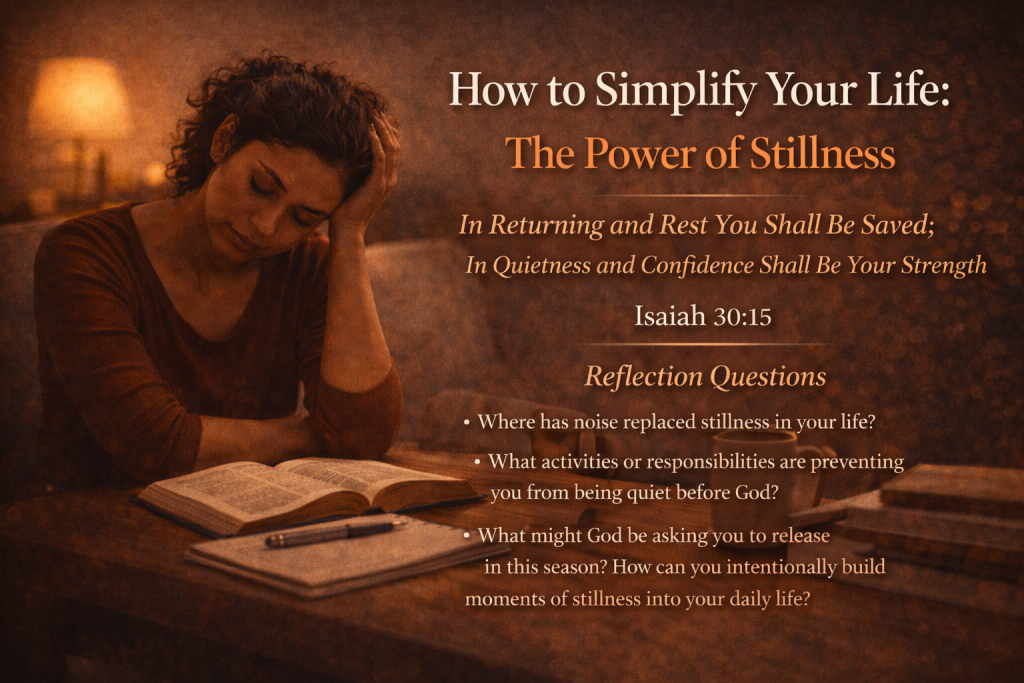
How to Simplify Your Life: The Power of Stillness

Life often becomes overwhelming not because there is too much to do, but because there is too little stillness. When everything is moving at once, clarity disappears. God never designed clarity to come through rushing; He designed it to come through stillness. Isaiah 30:15 reminds us that in returning and rest we find salvation, and in quietness and confidence we find strength. Stillness is not weakness; it is strength properly positioned.Simplifying your life begins by intentionally slowing down. Stillness creates space to hear God clearly and to assess what truly matters. Without stillness, decisions are driven by pressure rather than purpose. When the soul is quiet, priorities become clearer and unnecessary burdens are exposed.Many people struggle with complexity because they respond to noise instead of direction. Every demand feels urgent, every voice feels important, and every opportunity feels necessary. But clarity does not come from doing more; it comes from withdrawing long enough to realign. Jesus often withdrew from the crowds, not because He lacked compassion, but because stillness protected His clarity and strength.Stillness also helps you recognize what does not belong in your life. When life is noisy, you carry responsibilities that were never assigned to you. But in stillness, God separates the essential from the excess. Psalm 46:10 instructs us to be still and know that He is God. Knowing God more deeply often requires doing less, not more.Simplifying your life requires courage to release what creates noise—overcommitment, comparison, people-pleasing, and constant activity. These things fill your schedule but drain your strength. Stillness gives you the courage to say no without guilt and yes with confidence.Structure becomes meaningful when it flows from stillness. When you are still before God, routines are no longer burdensome; they become supportive. Prayer, rest, work, and growth find balance when they are built on a quiet, anchored spirit. Stillness restores order both internally and externally.Rest is not optional in a simplified life; it is essential. Rest renews strength and preserves clarity. Without rest, life becomes reactive and chaotic. With rest, decisions are thoughtful and aligned. Isaiah 30:15 makes it clear that strength flows from quietness, not exhaustion.A simplified life is a still life—not inactive, but anchored. It is a life where movement flows from clarity, not pressure. When you embrace stillness, your life naturally becomes lighter, clearer, and more aligned with God’s direction.

Reflection Questions

Where has noise replaced stillness in your life? What activities or responsibilities are preventing you from being quiet before God? What might God be asking you to release in this season? How can you intentionally build moments of stillness into your daily life?

When You Feel Confused About Your Life, Purpose, and Direction

Many women are genuinely confused about their lives. They love God, they desire growth, and they want to make impact, yet they are not sure whether they are truly making progress or merely staying busy. Spiritually, emotionally, and even practically, they feel unsure of where they stand. This confusion is often quiet, internal, and deeply exhausting.For many women, the confusion becomes heavier within marriage. On one hand, there is a strong sense in their heart about what God is stirring them to do. On the other hand, there is the voice of a husband who may not understand the burden, the timing, or the direction. Questions like “Why do you want to do this?” or “Is this really necessary?” begin to create doubt, hesitation, and discouragement. Over time, the woman begins to question herself, her calling, and even whether she heard God correctly.It is important to understand that confusion does not mean failure. Confusion often means transition. When God is shifting a woman from one level to another, clarity does not always come instantly. Sometimes clarity unfolds through obedience, growth, and maturity. Feeling confused does not mean you are behind; it may mean you are standing at the edge of something unfamiliar.Many women struggle because they are trying to balance obedience to God with respect for their husbands, but they do not know how to do both without feeling guilty or rebellious. The truth is that God is not in competition with marriage. However, purpose must be handled with wisdom. Purpose does not grow well in emotional arguments, impatience, or silent resentment. It grows through prayer, clarity, character, and timing.When a husband does not understand a woman’s calling, it does not automatically mean opposition. Sometimes it means the vision has not yet been communicated clearly. Sometimes it means the season is not yet ripe. And sometimes it means God is first developing the woman internally before expressing the assignment outwardly. Not every instruction from God requires immediate public action; some require preparation, growth, and inner strengthening.If you are confused, start by asking yourself honest questions. Am I growing in character alongside my desire to grow in impact? Am I seeking clarity from God or validation from people? Am I willing to wait for God’s timing, or am I rushing out of frustration? Confusion often lifts when alignment is restored.A woman walking in purpose must learn patience, wisdom, and emotional stability. Purpose does not demand pressure; it demands maturity. God is faithful to make things clear in due time. He knows how to align hearts, open understanding, and create peace within marriage without destroying unity.If you feel torn between what God placed in your heart and the lack of support around you, do not panic. Stay rooted in prayer, grow quietly where you are, build discipline, and allow God to shape both your heart and your season. Clarity will come. Direction will unfold. And when the time is right, what God has placed inside you will speak for itself.

You are not confused because you are weak. You are learning how to grow wisely.